Expense Reporting Without Guesswork
Reducing submission failures from 56% to 11% in usability testing
Context
Reducing submission failures from 56% to 11% in usability testing by shifting from a trial-and-error experience to a guided workflow.
Frequent travelers struggled to complete expense submissions, leading to repeated corrections and delays. Instead of improving the existing form, I reframed the problem as a guidance issue and introduced a step-by-step workflow.
the problem
Expense submission failed because it relied on frequent travelers interpreting the system
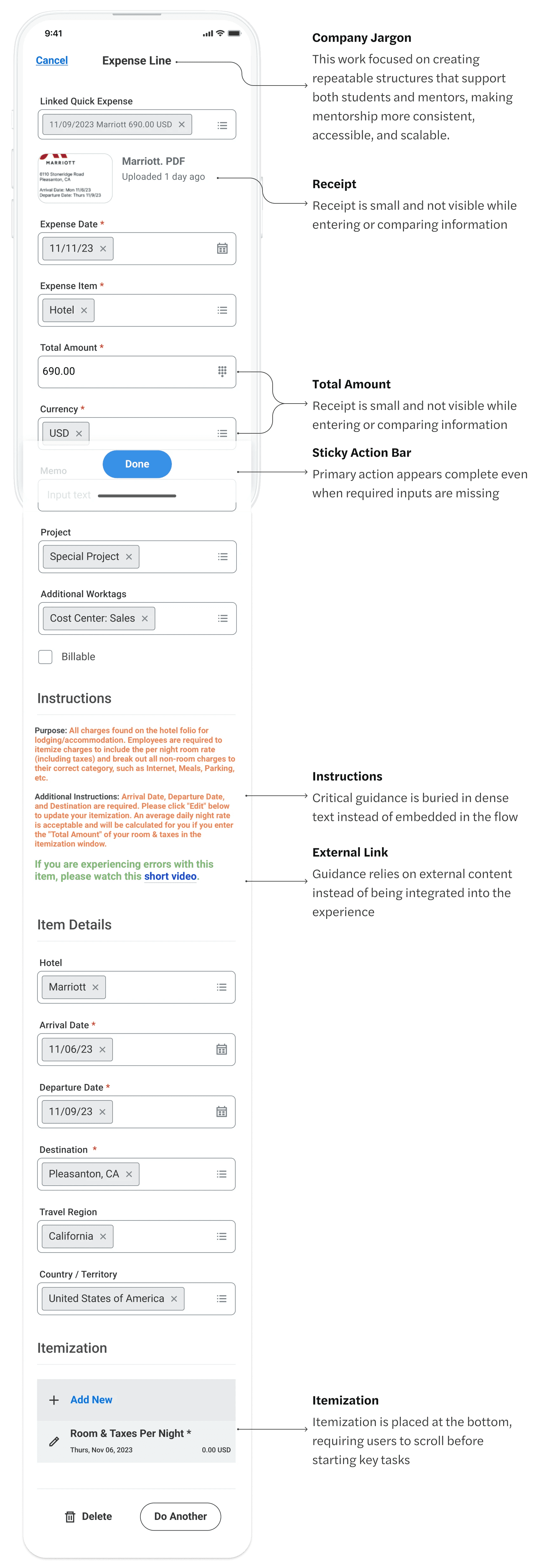
Submitting expenses required users to figure out what to enter, how to itemize it, and when to take action.
The product relied on written instructions and external videos just to complete the flow, signaling the experience was not intuitive.
That created a real problem. Workers open Workday to perform a specific task. Clock in. Submit work. Get something done quickly. A pop-up at login interrupts that moment, often leading to frustration and dismissal rather than participation.
When frequent travelers made mistakes, managers sent submissions back instead of correcting them, creating repeated correction loops.
WHERE THE EXPERIENCE BREAKS DOWN
the shift
Why fixing the form was not enough
We initially focused on improving clarity within the existing flow.
Improving clarity within the form did not change outcomes.
Frequent travelers still struggled because the experience required them to piece together how the process worked.
This meant even well-designed forms would continue to fail.
Instead of improving the form, I shifted the approach to guiding frequent travelers step by step through the submission process.
The Decision
From forms to guided workflows
We replaced the existing form-based experience with a guided workflow, shifting from frequent traveler interpretation to system-led progression.
This approach was made possible by ML-supported data, which allowed the system to surface relevant inputs and reduce manual entry.
This required introducing a new interaction model while working within existing technical constraints.
constraints
One API shared across web and mobile
Expense data varied by source, from fully populated transactions to partial or manual entry
No structured way to indicate required fields across customer configurations
Hybrid system combining modern UI with legacy infrastructure
Distributed teams across the US and Ireland
WHAT CHANGED
Replaced long-form input with structured, step by step progression
Introduced prompts that request only required information at the right time
Embedded validation within the flow instead of after submission
Designed a system that works across both modern and legacy environments
the solution
Instead of exposing a full form, the experience breaks submission into structured steps that request only the information needed at the right time.
Guidance is embedded throughout the flow, helping frequent travelers understand what to do next without relying on instructions or external resources.
Validation is integrated within each step, reducing errors before submission instead of after.
the results
Guided workflows improved task success and reduced errors in usability testing
Submission failures dropped by 45 percentage points, from 56% to 11%
Usability testing results
Submission failures reduced from 56% to 11%
Participants completed tasks with fewer errors and less confusion
Participants described the guided experience as easier to follow and more intuitive
“It walks you through the entire experience and makes everything easier to understand”
~ Participant 6
What this means
Fewer failures reduce rework for both frequent travelers and managers
Reducing interpretation lowers the likelihood of errors
The interaction model scales across expense types
ORGANIZATIONAL IMPACT
In parallel, I helped align a previously siloed organization across teams and regions
Brought together three design teams and multiple PM groups
Introduced consistent design syncs across web and mobile
Improved alignment on a shared API to reduce conflicting priorities
Established design as a decision maker within the team RACI
DELIVERY AND HANDOFF
As ownership transitioned to a team in Dublin, I prepared documentation, annotated designs, and led knowledge transfer sessions.
I designed value slices 1 through 6 and supported delivery through the first slice before transition.
Learnings
What I learned
Introducing diverse viewpoints early builds trust with cross-functional partners.
How I grew
I applied my design skills within real constraints at a larger scale, balancing platform limitations, legacy systems, and cross-team dependencies.
What changed
I began treating cross-functional alignment as a core part of the design process, not a supporting activity.