Hotel Expense Reporting
Reducing Hotel Expense Failures From 56% to 11% With a Guided Workflow

Context
Hotel expense reporting required travelers to verify itemized charges across expenses, receipts, and system inputs before they could move through the workflow confidently.
Itemization added additional complexity because room rates, taxes, parking, meals, and incidental charges each required separate comparison and verification.
This work explored a new machine learning-powered hotel expense experience designed to make hotel expense verification easier to navigate with confidence. I led the end-to-end design direction for the workflow, from early concept exploration through usability testing and iteration.
This work is based on usability testing with a prototype, not production analytics.
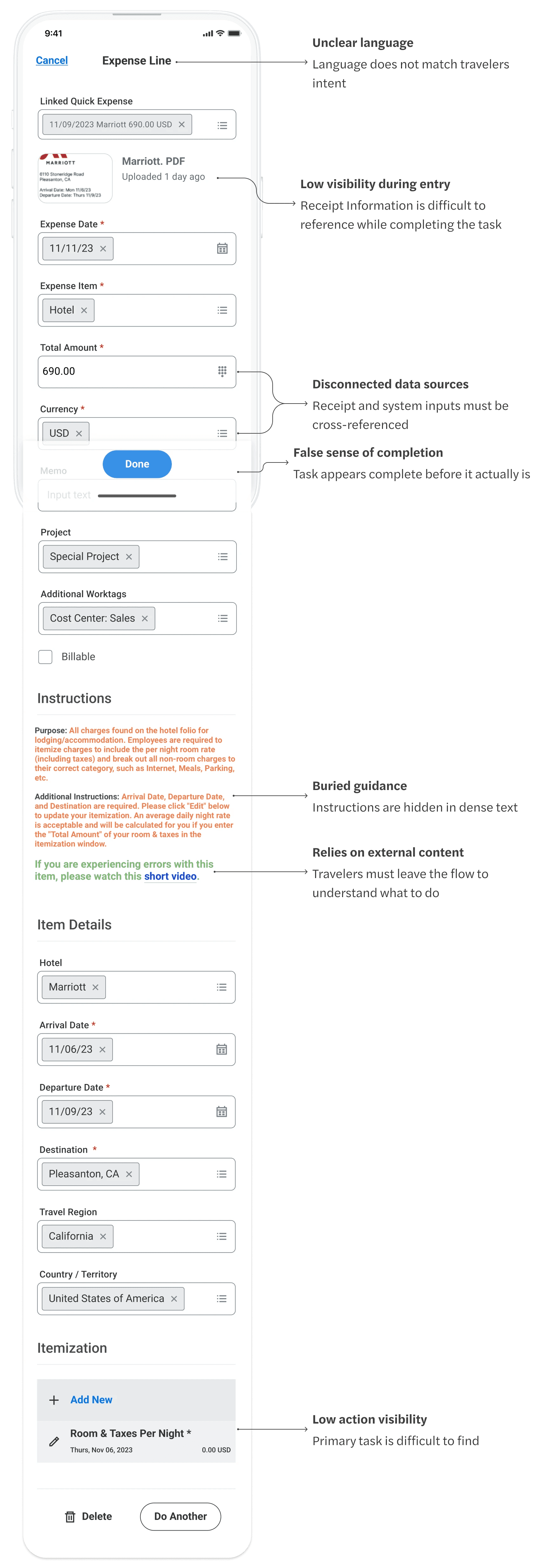
Travelers had to interpret too much throughout the workflow

Critical information was difficult to reference while entering and verifying itemized expenses.
Hotel expenses became especially difficult when room rates, taxes, parking, meals, and incidental charges each required separate verification and categorization.
Visual cleanup alone wasn’t enough


Early explorations focused on improving structure, progression, and visibility throughout the experience.
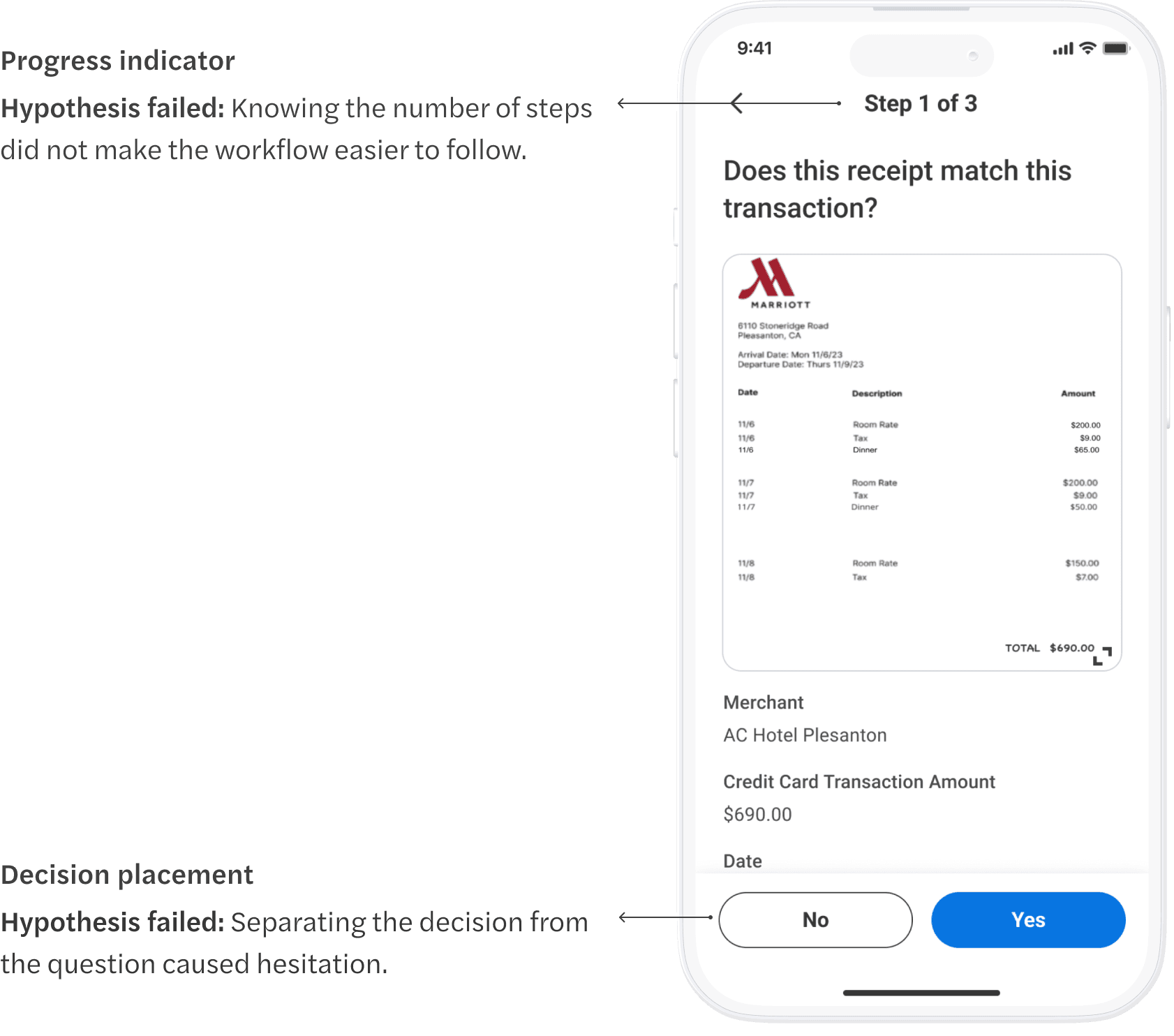
Verification needed to happen within the task itself

The workflow shifted from separating verification and progression into guiding travelers through one decision at a time. Receipt details and transaction information were brought together into a unified comparison view, making verification easier to complete in context.
A guided workflow focused on reducing verification effort
The redesigned workflow prioritized what required action first while keeping receipt details and verification within the task itself. Travelers spent less time scanning across the workflow, comparing information, and second-guessing what required attention before continuing.
The experience also accounted for situations where the system could not fully resolve the workflow automatically, including missing information, partial itemization, and adjusted expense categorization. Instead of breaking the workflow when automation was incomplete, travelers were guided through resolving those decisions directly within the workflow.
Preserving the workflow logic within system limitations

Before
Grouped by status for quick scanning
After
Removed sections due to constraints
Parts of the original direction were not feasible during the first implementation phase due to backend and configuration constraints.
The final implementation could not preserve the ideal structure, but the workflow still maintained visibility into what required attention and what was already complete.
The implementation changed, but the core goal remained the same: reduce verification effort by helping travelers understand what needed attention before continuing.
For travelers
Usability testing showed task failure dropped from 56% to 11% after the redesign
The guided workflow reduced the effort required for hotel expense submission, helping travelers complete itemized expenses with fewer failed attempts, fewer repeated verifications, and less uncertainty throughout the workflow.
For the business
Using conservative model assumptions, the redesigned workflow is estimated to save approximately 30,000 hours annually, or roughly $1.4M in productivity value, across the rollout population. This estimate reflects direct time savings during expense submission and excludes downstream operational effects such as reduced support overhead, faster reimbursement cycles, reduced manager review time, and lower onboarding friction.
For the organization
I also helped shift teams away from siloed workflows by improving alignment and shared decision-making across the broader group.
Delivery & Transition
Ensuring continuity across delivery
The project was designed across multiple value slices, with value slice 1 delivered before the remaining workflow direction transitioned to the Dublin design team.
To support continuity, I documented the workflow patterns, decision logic, and implementation rationale so the broader experience could continue evolving without losing the core interaction model behind the redesign.
Testimonials

Rohit Sudheendranath
Mobile Product Manager | Workday
Durojaiye’s expertise in mobile design ensured the expenses product aligned with established patterns. His guidance helped the team deliver a functional, usable, and successful mobile experience.
Elizabeth Stark
Product Designer | Workday
Durojaiye was instrumental in reimagining the expense submission experience. He collaborated effectively across Product and Engineering while delivering a clear strategic vision.