Hotel Expense Reporting
Reduced task failure from 56% to 11% in usability testing with a guided workflow
Context
Submitting hotel expenses in enterprise systems is often slow and error-prone. This case study focuses on improving how travelers complete hotel expense itemization with a new machine learning–powered experience.
The goal was to reduce errors, improve task completion, and help travelers move through the process with more confidence.
the problem
The system relied on travelers to interpret it.
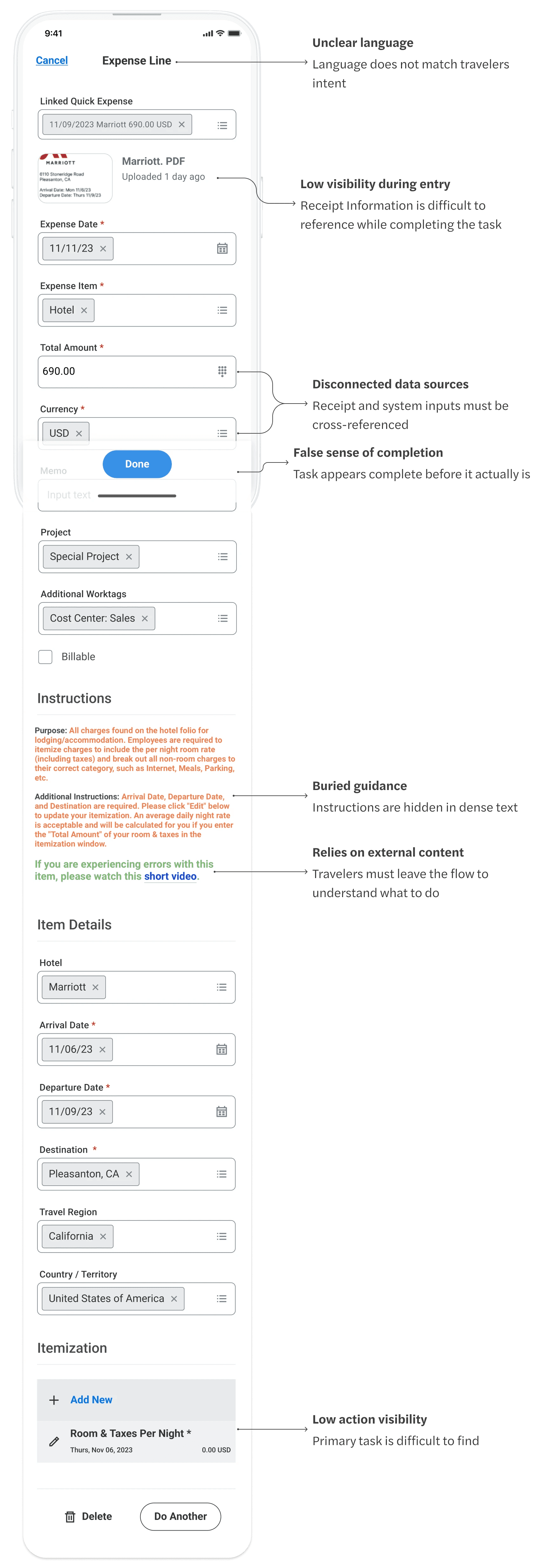
The existing experience required travelers to compare hotel receipt data with system inputs and decide what needed to be entered or corrected.
Even frequent travelers struggled to complete the task with confidence, having to interpret multiple pieces of information at once, second guess system behavior, and rely on trial and error to move forward.
Completion did not mean success. It often meant pushing through confusion.
the shift
Interpretation was causing errors
The issue was not missing instructions. The system relied on travelers to interpret multiple pieces of information at once.
When travelers had to compare receipts, system inputs, and required fields all at once, errors and hesitation increased.
The problem was not the form itself. It was how much interpretation the system required at a single moment.
What changed
From interpreting the system to guided completion
The redesign shifted from requiring interpretation to guiding travelers step by step.
Broke hotel expense itemization into smaller decisions
Asked questions at the right moment
Structured how receipt information is referenced and verified throughout the task
Helped travelers move forward with more confidence
The system uses machine learning to structure expense data and reduce manual interpretation.
A guided workflow leads travelers through submission step by step
Instead of exposing a full form, the experience breaks submission into structured steps that request only the information needed at the right time.
Guidance is embedded throughout the flow, helping frequent travelers understand what to do next without relying on instructions or external resources.
Validation is integrated within each step, reducing errors before submission instead of after.
Validation
Tested with frequent travelers using corporate credit cards
9 unmoderated usability sessions (1 per participant)
Participants were frequent business travelers
All had recent experience submitting hotel expenses
All used corporate credit cards
Current experience
Initial guided experience
Refined guided experience
The second iteration was updated based on feedback from the first round.
impact
Fewer failures and smoother completion
Most participants completed the refined guided flow successfully
Participants described the experience as easier and more intuitive
Travelers were able to recover and continue when issues occurred
“It walks you through the entire experience and makes everything easier to understand.”
Participant 6
ORGANIZATIONAL IMPACT
Shifting how expense workflows were approached
Introduced a guided approach that shifted how the team structured expense workflows
Influenced how future expense experiences could be designed
PROJECT TRANSITION
Ensuring continuity beyond delivery
Delivered the initial experience (value slice 1) before the project transitioned
Defined additional value slices to guide continued development
Structured the work to support a smooth handoff
Learnings
What I learned
Complex workflows fail when people are forced to interpret the system instead of being guided by it.
How I grew
I improved my ability to identify when problems stem from system behavior rather than UI.
What changed
I focus on structuring systems so people don’t have to interpret multiple inputs at once.
Testimonials

Rohit Sudheendranath
Mobile Product Manager | Workday
Durojaiye’s expertise in mobile design ensured the expenses product aligned with established patterns. His guidance helped the team deliver a functional, usable, and successful mobile experience.

Elizabeth Stark
Product Designer | Workday
Durojaiye was instrumental in reimagining the expense submission experience. He collaborated effectively across Product and Engineering while delivering a clear strategic vision.